Saturday, 26 May 2012

A favourite painting

Yesterday evening I gave a talk to the Immaculata youth group in Lewisham, part of a mini-series which we are doing on St Paul. The Scripture passage which we looked at was St Paul's address at the Areopagus in Athens (Acts 17). This section of Acts, together with Paul's departure from Athens for Corinth, is my favourite section of the Acts. I have long known about Leo von Klenz' painting of the Acropolis reconstructed. It is a magnificent painting housed in Munich. I insert here an image of the painting. It does, in fact, depict St Paul's speech at the Areopagus; you can see Paul speaking to a crowd in the forefront of the painting. The crowd even includes soem girls who are laughing at the speaker.

Thursday, 24 May 2012

The seminary and the new evangelisation

Fr Robert Barron brings the two together. Read his article here.

Monday, 21 May 2012

Hot off the press


Two years ago, Bishop Julian Porteous, anxiliary bishop in Sydney, published a Maual of Minor Exorcisms for priests, and a small maual of prayers for lay people who are encountering evil spirits. Both of these books have now been published by the CTS in London. I warmly recommend both of these books - the Manual to priests, and the Prayer Book to lay people.
Up till now priests who are not Exorcists have had few resources and little guidance in their ministry of confronting and thwarting evil. This new Manual of Minor Exorcisms places in priests hands a whole understanding of the priest's power over evil spirits, together with a ritual for use in their ordinary pastoral ministry. Powerful prayers have been drawn out of the Tradition and are here offered again to priests, with indications for their appropriate use.
The Prayer Book for those in spiritual affliction contains a whole inventory of prayers, again from the Tradition, and with indications for their appropriate use, which lay people can powerfully use against evil spirits.
Bishop Julian has done the Church, and especially priests, a great service in developing both these resources.    

Patrick Madrid and company

Here is an excellent photograph of Patrick Madrid and the men's group in Parramatta last Saturday morning. You can make me out just to the right of Patrick's head.

Sunday, 20 May 2012

Turning away from childish things.

I took part, yesterday morning, in a half day retreat for men led by Patrick Madrid, the American Apologist for the Faith. The event took place at Parramatta Cathedral and drew two hundred men of all ages. Many of them commented about wonderful it was to be a part of this masculine company of prayer and faith.
Patrick spoke very easily to this great crowd of men and his talk was warmly received; indeed, there was a discernible response of faith to his strong message.
He spoke first about the three hinges upon which one becomes a man: through mastering one's own body, particularly in the area of sexuality, through overcoming an innate selfishness, and through learning what it is to tell the truth, to be an agent of truth.
Then he spoke about the three levels of conversion which every man is called to undergo, not just once in life, but continually. First, there is spiritual conversion, which he keenly defined as letting Christ act in your life. Then there is moral coversion which hinges upon us turing away from anything which prevents us from being what Christ wants us to be. Finally, he spoke of intellectual conversion which he described as being open to formation - getting one's Catholic intellect in shape.
This tremendous proclamation about genuine masculinity concluded with the call to live the truth, speak the truth, and even to suffer for the truth. For most men, who have wives and families, these are the primary focus of their protecting mission: to protect their families, then to protect genuine culture, then to seek to advance the Kingdom of Christ.
What a fantastic vision of masculinity Patrick Madrid gave to us Sydneysiders! For more information visit http://www.patrickmadrid.com/ . 

Friday, 18 May 2012

A word from Cardinal Newman

These words are from a sermon which he preached in Advent 1835.

"This is what I have to say about the last persecution and its signs. And surely it is profitable to think about it, though we be quite mistaken in the detail. For instance, after all perhaps it may not be a persecution of blood and death, but of craft and subtlety only—not of miracles, but of natural wonders and powers of human skill, human acquirements in the hands of the devil. Satan may adopt the more alarming weapons of deceit—he may hide himself—he may attempt to seduce us in little things, and so to move Christians, not all at once, but by little and little from their true position. We know he has done much in this way in the course of the last centuries. It is his policy to split us up and divide us, to dislodge us gradually from off our rock of strength. And if there is to be a persecution, perhaps it will be then; then, perhaps, when we are all of us in all parts of Christendom so divided, and so reduced, so full of schism, so close upon heresy. When we have cast ourselves upon the world, and depend for protection upon it, and have given up our independence and our strength, then he may burst upon us in fury, as far as God allows him. Then suddenly the Roman Empire may break up, and Antichrist appear as a persecutor, and the barbarous nations around break in. But all these things are in God's hand and God's knowledge, and there let us leave them.
This alone I will say, in conclusion, as I have already said several times, that such meditations as these may be turned to good account. It will act as a curb upon our self-willed, selfish hearts, to believe that a persecution is in store for the Church, whether or not it comes in our days. Surely, with this prospect before us, we cannot bear to give ourselves up to thoughts of ease and comfort, of making money, settling well, or rising in the world. Surely, with this prospect before us, we cannot but feel that we are, what all Christians really are in the best estate (nay, rather would wish to be, had they their will, if they be Christians in heart), pilgrims, watchers waiting for the morning, waiting for the light, eagerly straining our eyes for the first dawn of day—looking out for our Lord's coming, His glorious advent, when He will end the reign of sin and wickedness, accomplish the number of His elect, and perfect those who at present struggle with infirmity, yet in their hearts love and obey Him."

The image above is a segment of Luca Signorelli's 'Last Judgement' from Orvieto Cathedral. Satan holds a 'Christ' figure in his embrace on a podium. But the figure which Satan is embracing is not Christ, but the AntiChrist.


Thursday, 3 May 2012

Three views for Christ: 3

The third and final vision for the Christian Formation of young people which I want to speak about is one for which I can only give a brief scetch: creating spirituality centres. Now I realise that these two words, 'Spirituality Centre', can make us think in terms of laberinths, enneagrams and ceramic therapy; what I am thinking of when I say 'Spirituality Centres' are places of formation which nurture and establish prayer in young peoples lives. Such centres then would be given over to helping young people to pray, to discover and establish a basic foundation to prayer in their lives, and to discover the richness of the Church's tradition in this regard by being properly introduced to some of the Church's classical spiritualities - Carmelite, Ignatian, monastic, family etc. This could be done through short or extended retreats and through personal Spiritual Direction. 
I know of very few such places and I really do believe that there is a need for them. Two such 'centres' which come to mind are:
The Diocesan Centre of the Sacred Heart of Jesus in Valladolid, Spain, http://www.centrodeespiritualidad.org/. You will need some Spanish here.
The Craig Lodge Family House of Prayer in Scotland, http://www.craiglodge.org/, which has enabled so many young people to grow in Christ.
I'm sure that there are other Centres which you could name - we need them. 

Monday, 30 April 2012

Three views for Christ: 2

A second vision for the Christian formation of young people looks to Houses of Discipleship. Residential houses for young men and women separately, in which young people who have left home and are either students or are working are able to establish a formation community together in order grow as men and women, and to grow in faith as Christian men and women.
Each house would live a simple rule of life and be led by a more mature person(s) who was competent for the role. Each person would have to self-fund their part in the house in order for it to be economically viable. Individuals could commit to live in such a house of discipleship, while working or studying, for one or more years.
The vision for each house and its life would need to be clear and simple; the basis of this vision is to enable the faith to take root, become incarnate, in the person's life. The rule of life would not be specifically directed, for instance to priesthood, religious life or marriage, but rather to enabling a fuller discernment, so that members of such a house would be well-disposed upon leaving, to take up whatever path in life God was calling them to (including that of becoming a part of a Youth Mission Team, for instance.)
The important factors in the creation of such an initiative are the acquiring of a property, having a clear vision and having appropriate and properly formed leadership. 

Thursday, 26 April 2012

Three views for Christ: 1

When you come to look at the Christian formation of young people today it is like looking at the Mountain of the Beatitudes; there are many views, many approaches. But there are three particular ways which I see and I would like to speak briefly about them here. 
The first is the development of local or cell groups. These are groups which are able to meet regularly and who have adequate leadership, a leadership which knows how to integrate the various dimensions: human formation, evangelisation and prayer, discernment at its various levels, and catechesis, together with the very important social dimension. 
The local group best comes into being where there are some already formed relationships between members; these relationships can then become the means to attract and include new members.  
Again a local or cell group whilst engaging in various activities and even organising events for others, needs to be person-centered. That is to say, the group exists primarily for the formation in faith of its members, and to enable them to support one another as people of faith.
Another factor which supports this kind of initiative is the character of the venue. The most important ingedient here is that the group is able to make the venue its own - that it becomes a place where they feel at home because, in a certain sense, they have made it into a home.
The three main ingredients for the ordinary life of the cell group are the social dimension (food is a very good way of establishing this), prayer and some specific formation input.
You can see this form of apostolate with young people in many places both inside the Catholic Church and also in the Evangelical churches. How do you get a cell group going? Pray it into being, and look for and form leaders for such an initiative. 

Friday, 20 April 2012

More household's like More's


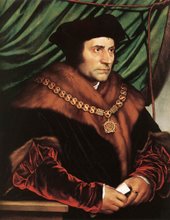
In reading Fr Peter Milward's excellent book "The English Reformation, from tragic reality to dramatic representation", Oxford, 2007, I was struck by the way in which the author referred to St Thomas More's household at Chelsea.

In the midst of the swirling controversies of the English renaissance/reformation, Sir Thomas More quietly and simply built up a Catholic culture around his home. The principal agent of this Catholic culture was simply hospitality. The many visitors who passed through the house, the meals, the many gatherings both informal and semi-formal, the conversations, the prayers which were led, were all able to be cast in the light of truth, the light of the Gospel, a light which was fast fading from early fifteenth century England.

What a patron to have if you are trying to build a Catholic household today. Again hospitality is the key. If you have a television, get rid of it, or unplug it and put it in the garage. Marginalise the computer and the iphone. The family table is second to none in terms of offering you a focus for hospitality. If there is a visitor in the area who has a particular gift in terms of the faith, invite him or her, and invite others so that more can be made of the gathering. You could think of organising, from time to time, particular events; a prayer time, a formation session, even a simple coffee morning. Let there be some focus on Christ and on the faith, but let in be a true social gathering, and let there be some prayer.

It is a good thing also, to consider building up a Catholic library in your home. With the culture taking a nose-dive, good books will disappear from the few book shops that are left, nor will they be referenced in any way by the culture. There is such a weatlth of great books, and somebody needs to preserve this heritage. Now is the time to act. Ask the Holy Spirit and St Thomas More for inspiration and direction.

Monday, 16 April 2012

Marking an anniversary

Last Saturday the Bishop of the French Diocese of Belley-Ars celebrated his seventy fifth birthday. Tomorrow, Wednesday, will be the twenty second anniversary of the foundation of the Societe Jean Marie Vianney by Mgr Bagnard.

Mgr Guy Marie Bagnard was chosen by John Paul II in 1987 to be the new Bishop of Belley-Ars. At that time Mgr Bagnard had been the rector of the Shrine of the Sacred Heart at Paray-le-Monial. This shrine is a focal point of the love of Christ because it was here that He revealed the whole teaching about the love of His heart, a love which Christ's priests are called to be channels of.

In 1988 Mgr Bagnard founded the new seminary in the village of Ars, the village of St John Vianney. Two years later he founded the priestly fraternity Societe Jean Marie Vianney. Looking back now, we can see what was in this new bishop's heart as he took up his pastoral office: to form priests and to uncover the beauty of the Priesthood.

As a member of the Societe I have met Mgr Bagnard on many occasions; each time I have been aware of the fatherhood of this holy bishop, and I have glimpsed how both an international seminary and an international priestly fraternity have been prayed into being by his priestly heart.

On one of the many visits to Ars which Fr Julian and myself have made, we took part in a Holy Hour in the large seminary chapel at which were present the seminarians and many priests and lay people of the Societe. While a deacon exposed the Blessed Sacrament and led the adoration prayers, Mgr Bagnard was in the front pew, deep in prayer throughout the whole hour. We could feel the power of his fatherly love and prayer. It was as if Jesus was pouring grace into the Church through the praying heart of this bishop.

May God continue to use Mgr Bagnard to form His Church, may He continue to bless the seminary and the priestly fraternity.

Friday, 13 April 2012

The secular idyll

That idyllic vision of life which Dawkins described on the 'Q and A' programme last Monday, in which everyone should have an opportunity to live their lives to the best of their ability and to make the world a better place, sounds absolutely delightful. Yet it is a vision of life which tends to exalt any kind of human culture, with the exception, of course, of Christian orthodoxy. But are all potential forms of human activity and culture good and desirable? The secular vision seems to say yes, and how dangerous this is.
Another hidden dimension of this idyll is that although the secular vision appears to embrace all forms of culture, except Christian orthodoxy. In fact the secular vision cannot at all tolerate the presence of Christian orthodoxy because it is a reminder of God's order, God's plan for humanity. This is especially true of Christian marriage and the Christian family which, institutionally, represent everything that the secular vision despises. What is now proposed as "same-sex marriage" at the level of equality with marriage, will not end there because the secular vision wants to remove all remnants of God's order in the world.
Nevertheless, God's Fatherhood which He has revealed to us is a real Fatherhood, by which He allows rebellious sons and daughters to experience the whole weight of their abandonment and wretchedness so that they can see the full effects of their sin, and so come to desire salvation. God's Fatherhood is given to us in a radical way in the parable of the Prodigal son. God desires that all men and women will come to Him, but we know that He will leave the rebellious to go on to experience the very worst that their rebelliousnous brings upon them. And then, when they cry out to Him, He is there with the fullness of a Father's love.

Thursday, 12 April 2012

A culture of opinion

It is hard for atheism to speak about its point of view without refering to God. Again, Richard Dawkins, on the prime-time viewing spot 'Q and A', debating the question of God's existence with Cardinal Pell, tried courageously to defend the atheist position whilst speaking about God and Revelation.
What became manifest during the ABC programme was no so much atheism, so called, but rather the agenda of contemporary secularism. Dawkins himself nicely expressed this form of secularism, a secularism which promotes the leading of worthwhile lives, making the most of our short lives here, making the planet as good as we can, and hoping to leave it better than we find it, whilst aggressively refusing to admit the God of Revelation, Jesus and the Church. At the same time contemporary secularism reveals itself to be a culture of opinion, whether these are well articulated, as in the case of Dawkins or whether uploaded from viewers kitchens using their iphone (as we experienced during the programme). All the while, the pseudo-intellectual mass media, through its agents, taking great delight in trivialising some of the most important human questions, and trying to belittle humanity and its relationship with God. And at the centre of the debate a courageous prelate of the Church making himself available to people to listen to them and to try to answer their questions.
Contemporary secularism is like paganism of old. The Church has encountered this attitude in every era; at the Areopagus, in the Colosseum, in the cities and in the country tribes, in her Universities and in her hospitals. And in each case what is revealed is the spiritual battle which the Church has been called to take part in. It is a real struggle, for in every age, men and women do not want to step out of the kingdom of the world, which is the kingdom of sin and death, and of Satan. What will it take for the men and women of today to step into the Kingdom of Christ, of grace and righteousness?
The 'Q and A' debate on Monday evening told us nothing new about the world (to which we have all belonged), but it did speak about the greatness of Christ's Redemption, about what He has delivered us from, and about the reality of the spiritual warfare today between the world and the Church. It is a warfare which goes beyond both opinion and deliberated argument, because it is about whether we will allow ourselves to be delivered from the kingdom of death and brought into Eternal Life.
Friday, 6 April 2012

Pointing the finger


With reference to my last post in which I took a side-swipe at secular culture, I wanted to state a reservation which I have. It is one thing to challenge and criticise secular culture, but it is another thing to challenge and criticise those who live secular culture. The former can be justified, but not the latter. As Catholics we cannot attack people who do not know Christ live and who consequently live far from Him. We have no right to judge. Nor is the new evangelisation a time for Catholics to be self-righteous. Christ may indeed need to teach many people (including ourselves), but it is for us to hold people before Him in our hearts.

Sunday, 1 April 2012

The Mirror of Galadriel


In Tolkien's "The Lord of the Rings" the elven queen Galadriel allows Frodo, the ring-bearer, to look into her mirror. The mirror itself is a draught of water which is taken from a secret spring and then poured into a special basin. Looking into this basin, rather than seeing one's own reflection, one sees images of events from the past, the present and even the future. It is a sort of "reality check" for Frodo, but one which requires some interpretation since the meaning of events is not always evident. Indeed, Frodo has to look into the mirror twice in order to even begin to see any image. And what he sees is ambiguous, it confuses him, and it draws him in - he almost falls into the basin!

The prevalent culture today is similarly ambigous and confusing, and it draws us in. Like the images which are reflected in Galadriel's mirror we need to take a second look, a second look which is more discerning than the first.

The secular culture in which most of us live offers no guide, no interpretation, no direction. But, if we take a second look then we can see that its primary focus is "self"; what it proposes is, first remove God from the scene and then seek success in whatever you attempt.

Secular morality is worth distinguishing for what it is: it focusses on virtually unobtainable goals as the purpose of and motivation for living, and then leaves you to struggle desperately towards them. The goals are things like inordinate wealth, beauty, prestige and dominance. The best image I can think of for today's secular morality is the weights gym. I'm not against gyms or keeping fit, but battling against serious odds in order to achieve an ephemeral goal is the content of todays secular ethic. It is an extremely demanding morality.

Two other points stand out in relief when one reflects upon today's secular culture. First, it operates at an IQ level of not higher than 14. You can test this out by turning on the television for a few minutes. Secondly, secular cultures costs a lot; in comparison with the family meal table and the table of the Lord's Body and Blood, secular culture starts at Cafe prices and rises steadily to encompass cars which have the same retail value as some family homes, and wrist watches which have a retail value greater than many people's annual wage.

Yet, so many are drawn in by this culture, and the homogenous nature of the secular world means that we rarely have a different viewpoint by which to assess our options and personal culture. Unlike Frodo, who had a humble elven queen to help him see the juxtaposition of the values which presented themselves to him.

What is most worrying however, are the number of baptised people who square themselves up to live according to secular culture. Now that Holy Week has begun, this is not the time to plaster over our personal culture, but rather to allow Christ to take centre stage in our lives.

Wednesday, 21 March 2012

Christian attitude


At the Last Judgement we don't want our near colleagues to point us out and say that they had no one to show them the way.

That process of formation in Christ which is common to all of the baptised is threefold:

First, the assimilate the Faith into our minds and hearts.

Second, to express the faith in our lives.

Third, to witness to the faith in life.